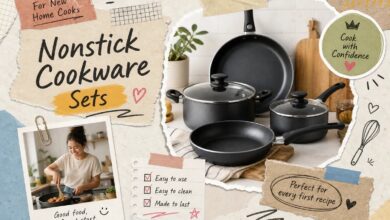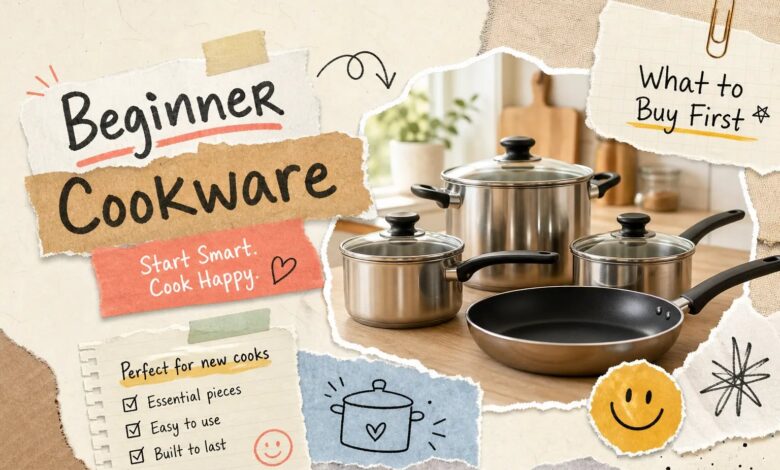
You open a product listing for a “12-piece cookware set” and immediately feel like you’re getting a deal. Twelve pieces sounds like a complete kitchen. But count the lids separately, throw in a bonus spatula and a tiny 6-inch pan you’ll never use, and the actual cooking vessels drop to five or six. Sometimes fewer. Shopping for your first beginner cookware set is genuinely confusing, and this is exactly how cookware marketing works, tripping up almost every beginner who’s trying to build a real kitchen on a real budget.
At NestKitchenMeals, we cover exactly this kind of decision for people building a functional kitchen without wasting money on things that collect dust. The goal here isn’t to tell you that one set is perfect for everyone. It’s to give you a clear, honest framework: which pieces actually matter, which materials suit your cooking style, and which starter cookware set makes sense for your budget and cooktop. By the end of this guide, you’ll have a confident answer to all three. For more on this, see our meal prep guide.
What a good beginner cookware set should include (and what filler looks like)
A beginner doesn’t need 12 pieces. That number creates the illusion of a complete kitchen while delivering a lot of redundancy. What you actually need is 4 to 6 versatile pieces that cover the core tasks: frying, boiling, sautéing, simmering, and making one-pot meals. Start there and buy more only when a specific gap shows up in your cooking.
The 4 essential cookware pieces every starter set should include
Many beginners find a 10-inch skillet to be their most-used pan. It handles eggs, pancakes, seared chicken, and sautéed vegetables with ease. A 2-quart saucepan with a lid earns its spot for grains, sauces, reheating, and small-batch boiling. The 3- to 4-quart sauté pan with lid gives you a wider cooking surface than the saucepan, making it ideal for one-pan dinners, shallow frying, and anything that needs room to move around. Finally, a 5-quart stockpot with lid handles pasta, soups, chili, and batch cooking without the crowding problem you’d hit with smaller pots.
Optional fifth and sixth pieces worth adding
If you already know you like making stews, chili, or braised dishes, a Dutch oven is a deliberate and worthwhile addition. It goes from stovetop to oven without complaint, holds heat beautifully, and doubles as a stockpot in a pinch. A steamer basket is usually an inexpensive add-on that works inside your existing stockpot, making it worth considering if you batch-cook vegetables regularly. These aren’t default purchases, add them when you know you’ll use them.
How brands count 12 pieces from 6 actual pans
The simplest trick is counting lids as separate pieces. A sauté pan with a lid becomes two pieces. A saucepan with a lid becomes two more. Stack up four pots and their matching lids and you’re already at eight before you’ve added a single bonus item. Some sets also include a small egg pan or a silicone spatula, each counted as an additional piece in the total. When you shop, count only the actual cooking vessels. That number tells you what you’re really getting.
Nonstick, stainless, tri-ply, enameled cast iron: choosing the right beginner cookware set material
Most beginners default to nonstick because it sounds like the easiest option. Sometimes that’s the right call. But the material you start with shapes your cooking habits and your budget over time, so it’s worth understanding what each one actually delivers before you commit.
Why nonstick is the easiest entry point (and where it falls short)
Nonstick cookware is genuinely forgiving for eggs, pancakes, fish, and anything delicate that tends to stick at low heat. It needs less oil, cleans up in seconds, and doesn’t require much technique. The tradeoff is durability: the coating wears down faster than any other material, especially when exposed to high heat, metal utensils, or harsh scrubbing. Nonstick coatings wear out sooner than metal cookware and often require replacement after a few years of regular use. It’s the right starting point for beginners who want zero frustration right out of the gate, but go in knowing it won’t be your last pan.
Tri-ply stainless steel: harder to start, longer payoff
Tri-ply stainless steel is built from three bonded layers, typically stainless steel on the outside, an aluminum core in the middle for even heat distribution, and stainless steel again on the cooking surface. It handles high heat, sears proteins properly, and is nearly indestructible. The learning curve is real: if you add food to a cold or insufficiently oiled stainless pan, it sticks.
The fix is technique. Heat the pan until a drop of water beads and rolls across the surface instead of evaporating immediately, that’s your cue to add fat and food. It’s a commonly recommended method among cooking instructors and works consistently once you’ve practiced it a few times. Once you learn it, stainless becomes one of the most versatile tools you own. It’s the right choice if you want a set that lasts a decade and teaches you to cook properly along the way.
Enameled cast iron: the niche option for specific cooking styles
Enameled cast iron is heavy, slow to heat, and slow to cool, which makes it excellent at retaining steady heat for braises, soups, and stews. Unlike bare cast iron, it doesn’t require seasoning and cleans up easily with warm soapy water. The downside for beginners is that it’s not an everyday pan. Scrambled eggs in an enameled Dutch oven is an uncomfortable experience. Only consider this material if you already know you want to make chili, short ribs, or slow-cooked soups regularly. Otherwise, start elsewhere and add it later.
Best beginner cookware sets in 2026 by budget
These three picks cover the most common price points for someone setting up their first real kitchen. Each recommendation is specific rather than hedged, because vague advice doesn’t help you buy anything.
Budget pick: Tramontina Gourmet 8-Piece Tri-Ply Clad
This set is often priced under $150 in 2026 and delivers tri-ply stainless construction that performs close to sets at twice the price. Wirecutter included it as a strong budget pick in their 2026 cookware testing, and the piece count is practical rather than inflated. For a beginner who wants real stainless steel without a premium price tag, this is the safest bet in the budget tier. It works on all cooktops including induction, and most configurations are oven-safe up to 500°F.
Midrange pick: Cuisinart Multiclad Pro 12-Piece Set
In the $150 to $250 range, the Cuisinart Multiclad Pro is the most broadly recommended option in 2026 testing roundups. Yes, the 12-piece count includes lids, but the actual cooking vessels form a genuinely useful starter lineup. The multi-clad stainless construction handles everyday cooking well, it’s induction-compatible, and real-world owners report strong durability with mostly cosmetic complaints over time. If you want stainless steel as your first serious set without a premium price tag, this is the best overall value in the middle tier.
Investment pick: All-Clad D3
All-Clad D3 is the benchmark that other sets get compared against in nearly every major cookware test. It’s oven- and broiler-safe up to 600°F, induction-compatible, and built to last for decades with normal use. The limited lifetime warranty backs that up. This isn’t exclusively for advanced cooks, it’s for anyone who wants to buy once, buy well, and stop thinking about cookware. The price is the only real barrier. If your budget allows it, the D3 is a set you grow into rather than out of.
What to check before you hit buy
Even the right set becomes the wrong purchase if it doesn’t work with your cooktop or can’t handle the temperatures your cooking requires. Run two quick checks before you finalize any order.
Induction compatibility and cooktop matching
Induction cooktops require magnetic materials to generate heat, which rules out most plain aluminum pans and some nonstick sets. The simplest test: hold a refrigerator magnet firmly against the bottom of the pan. If it sticks, the pan is induction-ready. Among the recommended sets above, the Tramontina Gourmet Tri-Ply Clad, Cuisinart Multiclad Pro, and All-Clad D3 are all induction-compatible. If you have a gas or electric coil cooktop, this check is less critical, but it’s still worth knowing so you’re not locked out if you upgrade your kitchen later.
Oven-safe temperature ratings and handle materials
All-Clad D3 handles up to 600°F, which covers roasting, broiling, and finishing dishes in a hot oven. Many nonstick sets have lower oven-temperature limits, often in the mid-300s °F, though exact limits vary by brand and model. Sets with plastic or silicone handles often can’t go in the oven at all; metal handles allow full oven use at higher temperatures. If you regularly start dishes on the stovetop and finish them in the oven, this detail matters more than the price tier. Also check whether the oven-safe rating applies with the lid on or off, since glass lids often lower the maximum temperature significantly.
The right cookware set only works if you know how to use it
Buying a good set is step one. Knowing how to cook with it is step two, and a lot of beginners skip that part, then blame the pan when something sticks or burns.
The most common beginner mistakes with new pans
With stainless steel, the biggest error is cranking the heat too high and expecting the pan to behave like nonstick. Food sticks, the pan scorches, and frustration sets in fast. The fix is patience with preheat and proper fat management, not a different pan. Piling too much food in the pan is another common misstep, an overcrowded pan drops in temperature, which stops browning and starts steaming instead. Dropping cold or wet food straight from the fridge into a hot pan has the same effect, pulling down the surface temperature and encouraging sticking. These are skill gaps, not equipment problems. A beginner with a $60 nonstick pan and solid technique will outperform someone using All-Clad with no fundamentals.
Where NestKitchenMeals picks up where the pan leaves off
Once you have your set, the real work starts. NestKitchenMeals publishes beginner cooking technique content built specifically for people who just stocked their first kitchen: how to cook chicken breast without drying it out, basic knife skills that build speed, and efficient methods for weeknight dinners, including one-pot dishes that are ideal for breaking in a new stockpot or sauté pan. The pans are just the foundation. The cooking content on the blog is where you actually learn what to do with them. Start with the beginner cooking tips section and work through the weeknight dinner recipes that match the pieces you just bought.
Making your pick with confidence
Here’s the short version of this first cookware set guide: if you want the easiest possible start with minimal learning curve, go with a quality nonstick set or a comparable induction-ready option in your price range. If you want one beginner cookware set that lasts a decade and makes you a better cook, go tri-ply stainless and choose between the Cuisinart Multiclad Pro for value or the All-Clad D3 if budget allows. Either way, 4 to 6 real cooking vessels is the actual target, not 12 pieces on a product listing.
With the right beginner cookware set and a bit of practice, you’ll actually enjoy cooking at home. Technique, repetition, and the right recipes are what turn a decent set into a kitchen worth spending time in. Explore the beginner cooking content at NestKitchenMeals when you’re ready to put those new pans to work. See also: kitchen decor.