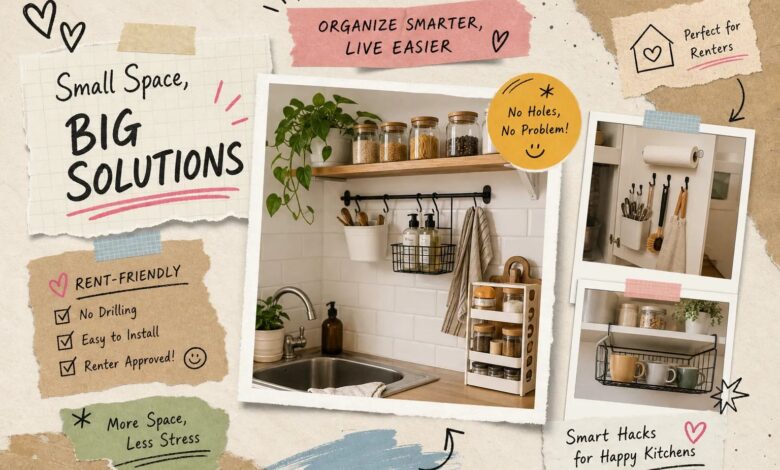
If you rent, you already know the standoff: a kitchen that’s too small, a landlord who expects the walls back in perfect condition, and zero permission to drill a single hole. The counters disappear under clutter, the cabinet above the fridge holds exactly three things, and the under-sink cabinet has become a dark, damp mystery. The good news is that the best small kitchen organization hacks for renters don’t require a single screw, anchor, or landlord conversation. Most of the products covered here cost under $30, and many run closer to $10 to $15.
This guide is part of NestKitchenMeals’ ongoing series of budget-friendly kitchen product picks and space-smart storage ideas, built specifically for real apartment kitchens. What follows isn’t a Pinterest mood board. It’s a practical weekend action plan with real product categories, estimated costs, and a shopping checklist you can use immediately.
Best small kitchen organization hacks for renters: No-drill wall storage that actually holds weight
The Command hook system is the most reliable starting point for renter-friendly wall storage. Small hooks (2 to 3 lb) handle dish towels and light utensils. Large hooks (5 lb) work for heavier cooking tools and bags. Jumbo hooks (7.5 lb) can support small organizers and caddies. The 15 lb heavyweight hook handles under-cabinet caddies and wall-mounted wire organizers without budging. The rule is simple: match the hook size to the item’s weight with some margin to spare, and always use the stretch-to-release removal method when it’s time to move out. Pull the strip straight down, parallel to the wall, and it releases without damaging paint.
Adhesive floating shelves
If hooks aren’t enough, adhesive floating shelf sets are the next step up. Acrylic shelf sets run about $20 for two and hold up to 7 lb each, which is plenty for a row of spice jars or a few mugs. The High & Mighty Modern Floating Shelf handles 15 to 20 lb on an 18 to 24 inch shelf and installs without any tools, making it one of the strongest no-drill shelf options in this category. One important surface note: adhesive shelves perform best on smooth, painted drywall. Textured or semi-gloss walls reduce adhesion.
Magnetic shelves for zero wall contact
For kitchens where wall space is genuinely nonexistent, magnetic shelves are a zero-commitment solution. A magnetic shelf sticks directly to the side of your refrigerator or a metal range hood and holds up to 7 lb, enough for a few spice jars, a box of foil, or a small container of cooking utensils. For maximum capacity, try stacking two magnetic shelves vertically on the fridge’s side panel to double your surface area. No wall contact, no lease risk, and the whole setup moves with you when you leave. Prices typically fall in the $10 to $20 range, making this one of the lowest-cost small kitchen storage hacks available.
Tension rods and over-door organizers for pans, lids, and cutting boards
A tension rod mounted between two cabinet walls creates an instant hanging rail for pot lids, pan covers, and lightweight cookware accessories. It costs almost nothing, installs in seconds, and removes in one pull. For heavier pans, use the rod as a divider rather than a load-bearing bar; pair it with S hooks on a freestanding wire shelf for hanging pan handles instead. One critical step before buying: measure the inside width of your cabinet so the rod fits snugly without slipping. On glossy laminate or painted wood, adding a rubber shelf liner at each contact point prevents sliding over time.
Over-the-cabinet organizers are the apartment kitchen organization idea most renters walk right past at the store. These rest on the top edge of the cabinet door, which means they do make contact with the door surface, but they require no tools and typically leave no marks on standard finished doors. On thinner or unfinished doors, a felt pad between the hook and the wood prevents any potential scuffing. They’re ideal for storing cutting boards vertically (which also prevents warping), separating lids by size, and organizing cleaning supplies on the under-sink door. Models rated for doors up to 1.5 to 1.65 inches thick fit most standard rental cabinets. The SimpleHouseware style with a 1-inch hook fits even thinner doors. Use these on every door you have, including pantry doors and the inside of the sink cabinet.
Best small kitchen organization hacks for renters: Inside cabinets and drawers
Shelf risers are the fastest way to reclaim wasted vertical space inside a cabinet. Many apartment cabinets have roughly 12 to 18 inches of vertical clearance, and without a riser, half that space goes unused above stacked plates or bowls. A stackable riser creates a second level without any fasteners and typically costs $15 to $40. Use them to separate pantry categories, lift canned goods, or create a dedicated mug shelf inside a cabinet that would otherwise hold three things in a single stack.
Expandable cabinet bins work similarly for organizing spices, packets, and small containers. They adjust to fit different shelf widths and keep items grouped so nothing gets pushed to the back. The organizing rule that works in nearly every apartment kitchen: go vertical first, then group items by how often you use them. Daily items belong at eye level and arm’s reach; things you use once a month go higher or deeper.
Drawer organizers are the easiest single-afternoon project in this entire guide. Compact trays in the 6 to 7 inch depth range fit most apartment kitchen drawers without any modification. Expandable versions are the best buy because they adjust to the exact drawer width instead of leaving gaps. Keep flatware and cooking tools in one tray and measuring spoons with small gadgets in another. At $10 to $30, this is the lowest-cost, highest-visibility improvement you can make to a chaotic kitchen drawer.
Inside deep cabinets or pantry shelves, a lazy Susan turntable solves the “things disappear at the back” problem without any installation at all. Set it on the shelf, load it with oils, vinegars, and sauces, and spin it to reach whatever’s behind. Tiered risers do the same for canned goods. Both options cost $15 to $25, require no tools, and are fully portable when you move.
Under-sink and countertop storage with zero tools
The under-sink cabinet is the hardest spot to organize in a rental kitchen because the plumbing configuration makes standard shelves useless. A two-tier adjustable caddy or sliding pull-out rack is built specifically for this problem. The key word when shopping is adjustable (not fixed-height), because no two under-sink spaces have the plumbing in the same spot. Basic two-tier caddies run $15 to $35. Sliding pull-out systems with more configuration options run $30 to $70, though check individual product specs, since some higher-end sliding systems include optional mounting hardware. Either way, the goal is to get everything off the floor of that cabinet and into organized, accessible layers.
A rolling kitchen cart is the single biggest upgrade a renter can make to a small kitchen. Carts in the 15 to 20 inch depth range and under 40 inches wide fit most apartment kitchens without blocking workflow or creating a squeeze point. Entry-level options start around $30 at IKEA (the NISSAFORS utility cart at $29.99 is a solid budget pick at that price) and run up to $100 to $180 at Home Depot, Wayfair, and Amazon for sturdier builds with more storage. It pulls double duty: it adds counter space when you’re prepping and rolls out of the way when you’re done. For renters with no kitchen island and a counter that’s already covered, a cart adds functional square footage, not just storage.
What needs landlord approval and what doesn’t
Most of the no-drill kitchen storage solutions in this guide are generally safe to use without landlord permission: freestanding organizers, rolling carts, tension rods, over-the-door hooks, magnetic shelves, drawer organizers, turntables, and shelf risers are all freestanding or non-permanent. They typically remove in minutes without leaving marks, but it’s still worth checking your lease and testing any product against surfaces before full installation, since magnets can occasionally scratch appliance finishes and over-door hooks may scuff thinner cabinet doors. You can implement the majority of this guide the same weekend you read this article.
Adhesive hooks and floating shelves are a small gray area. They’re technically removable, but they carry a low risk on older or low-quality paint. Before applying adhesive strips to any large wall surface, test on a small, inconspicuous spot first and commit to the stretch-to-release removal method when you move. Some leases have specific language banning adhesives entirely, so a quick read of your lease, or a casual text to your landlord before covering a wall in Command strips, is worth doing. Protecting your security deposit comes down to one thing: leaving the walls in original condition. Most standard leases allow small, removable products, but damage from peeling paint or residue is typically classified as tenant-caused and comes out of the deposit.
Your weekend shopping checklist with real costs
Here’s the full product list for a complete kitchen overhaul, with approximate price ranges you can use as a shopping guide:
- Adhesive hooks (Command Medium/Large/Jumbo): $5 to $15 per pack
- No-tool floating shelf set: $20 to $35
- Magnetic fridge shelf: $10 to $20
- Tension rods: $5 to $15
- Over-the-cabinet door organizer: $15 to $30
- Shelf risers for cabinets: $15 to $40
- Drawer organizer trays: $10 to $30
- Lazy Susan turntable: $15 to $25
- Under-sink two-tier caddy: $15 to $35
- Rolling kitchen cart: $30 to $180 depending on size and build
Adding up the low and high ends of each item, a full kitchen overhaul using everything on that list runs approximately $145 to $405, a rough estimate based on the ranges above and actual retail pricing across major retailers. If you’re working with a tight budget, start with the drawer organizers, the under-sink caddy, and one set of cabinet shelf risers. Those three clear the most daily frustration for the lowest spend.
Every product category on this list has a dedicated buying guide on NestKitchenMeals, written from a home cook’s perspective for renters and budget shoppers. Instead of sorting through hundreds of listings on your own, the NestKitchenMeals kitchen organization and product sections give you vetted picks with real price points and use-case notes for small apartments. It’s the shortcut between reading this article and actually shopping.
Start this weekend, not someday
The best small kitchen organization hacks for renters work because they stack on each other. Start with adhesive hooks on the walls, tension rods inside the cabinets, over-door organizers on every cabinet door, and a rolling cart to reclaim counter space. None of these require a landlord’s permission, none leave damage, and none take more than an afternoon to set up.
If you’re deciding where to start, go straight to the under-sink cabinet and your main utensil drawer. Those two spots create the most daily chaos and have the most immediate payoff once they’re organized. Once those are done, organizing the rest of the kitchen becomes straightforward.
When you’re ready to shop, head to NestKitchenMeals’ kitchen organization and affordable product picks sections for curated recommendations across every category in this guide. No endless scrolling, no guessing on quality. Just the picks that work for real apartment kitchens.