Meal Prep

30-Minute Meal Prep Sunday Routine: The Complete Step-by-Step Guide

A 30-minute Sunday meal prep routine sounds too good to be true, but it works if you stop trying to cook five finished meals and start building components instead. This guide walks through the exact philosophy, tools, and minute-by-minute timeline that makes a real 30-minute prep session possible, plus how to shop for it, adapt it to your diet, scale it for a family, substitute ingredients on the fly, and keep it from getting boring by week three.

Why a 30-Minute Sunday Routine Beats an All-Day Prep Session

Split image comparing an exhausting all-day prep session to a calm 30-minute routine

Most people quit meal prep not because it doesn’t work, but because they start with a four-hour Sunday marathon that’s impossible to sustain long-term. A 30-minute routine is realistic enough to actually stick with week after week, which matters more than any single elaborate prep session ever could. Shorter, more frequent prep also means fresher food by midweek, since you’re not eating a dish that sat in the fridge for six days. The real unlock is realizing you don’t need to cook complete meals on Sunday — you need to cook a handful of interchangeable components that combine into different meals throughout the week, which is dramatically faster than planning and executing five distinct recipes.

The Prep Philosophy: Building Blocks, Not Finished Meals

Flat lay of separate bowls of cooked chicken, rice, and roasted vegetables unassembled

The entire system rests on one shift in thinking: prep proteins, carbs, vegetables, and sauces separately, then assemble different combinations each day rather than committing to five identical meals on Sunday. One roasted chicken breast can become a salad on Monday, a wrap on Tuesday, and a grain bowl on Wednesday, just by changing what it’s paired with. This building-block approach is also what makes 30 minutes realistic, since you’re batch-cooking four or five components in parallel rather than executing complete recipes one at a time. For more on why variety matters this much, see our guide on meal prep without getting bored.

Grocery Shopping for the Week

Grocery haul of chicken, rice, broccoli, and bell peppers on a counter

Because this system relies on a small number of interchangeable components rather than five separate recipes, the grocery list is short and repeats a lot from week to week. A typical list covers one protein (about 2–3 pounds for a household of two), one grain (2 cups dry rice or quinoa), two vegetables (roughly 2–3 pounds total), and the ingredients for two sauces — usually just olive oil, vinegar or lemon, garlic, and a couple of spice blends you likely already own. Buying the same core ingredients most weeks also means you get faster and more efficient at shopping over time, since you’re not hunting down a new list of specialty ingredients every Sunday.

Before You Start: The 10-Minute Setup

Hands laying out empty glass containers and ingredients for meal prep

The real time-saver isn’t the cooking itself — it’s doing your thinking in advance so Sunday is pure execution. Before you start the clock, decide on one protein, one grain or starch, and two vegetables for the week, and pull everything out of the fridge and pantry so you’re not searching mid-prep. Preheat the oven, fill a pot with water for grains, and lay out your containers so assembly at the end is fast. This setup takes about ten minutes done the night before or first thing Sunday morning, and it’s what actually makes the 30-minute window achievable — without it, you’ll burn through half your time just figuring out what you’re making.

Minute-by-Minute: The 30-Minute Routine

Kitchen timer on a counter next to sheet pans going into the oven

Here’s how the 30 minutes actually breaks down once your ingredients are staged and ready to go:

  • Minutes 0–5: Preheat the oven, season your protein, and get it on a sheet pan. Start a pot of water boiling for grains.
  • Minutes 5–10: Chop vegetables while the oven preheats, and toss them with oil and seasoning on a second sheet pan.
  • Minutes 10–25: Both sheet pans go in the oven together; grains cook on the stovetop during the same window. This is your hands-off cooking time — use it to wipe counters or prep a quick sauce.
  • Minutes 25–30: Pull everything out, let it cool slightly, and portion into containers. Add sauces or dressings in small separate containers so nothing gets soggy.

The key to hitting 30 minutes is cooking everything in parallel using the oven’s full capacity and the stovetop at the same time, rather than doing each component sequentially.

Protein Base: What to Cook in Bulk

Raw chicken thighs seasoned and arranged on a sheet pan

Pick one protein that roasts or sears quickly in bulk. Chicken thighs or breasts on a sheet pan, ground turkey or beef browned in one pan, or a rack of salmon fillets all cook in 15–20 minutes and yield enough for the whole week. Season simply — salt, pepper, and one spice blend — so the same protein can go in multiple flavor directions depending on what sauce or seasoning you add at mealtime. Beans or lentils are a fast plant-based option that needs no active cooking time beyond draining and rinsing a canned version, or a quick 20-minute simmer from dry.

Carb Base: Grains and Starches

Pot of rice cooking on the stovetop with steam rising

Rice, quinoa, or farro all cook unattended on the stovetop while your protein and vegetables roast, which is exactly why they fit into the 30-minute window — they don’t need active attention once the water’s boiling. A rice cooker or instant pot removes even that step if you own one, since you can start it and walk away entirely. Roasted or microwaved sweet potatoes and potatoes are another fast option, especially if diced small before roasting, which cuts their cook time roughly in half compared to roasting them whole.

Vegetable Base: Roasting and Chopping

Broccoli and bell peppers being chopped on a cutting board

Roasting is the fastest hands-off method for cooking vegetables in bulk — broccoli, bell peppers, zucchini, and green beans all roast in 15–20 minutes at 400–425°F, which lines up perfectly with your protein’s cook time on a second sheet pan. For vegetables you’ll eat raw, like a salad base or slaw, washing and chopping them during the oven’s hands-off window means they’re ready without adding any extra time to your total. Buying pre-washed greens and pre-cut vegetables when your budget allows is a legitimate time-saving shortcut, not a shortcut to feel guilty about.

Sauces and Dressings That Tie It Together

Three small jars of sauce lined up on a counter

A good sauce is what keeps the same protein, grain, and vegetable combination from tasting repetitive across the week. Keep two or three simple sauces on rotation: a basic vinaigrette, a yogurt-based sauce with garlic and lemon, and a soy-based sauce with ginger and sesame oil cover a wide range of flavor profiles with minimal ingredients. Make these in the few minutes while the oven’s running, and store them in small jars or containers separate from the rest of the meal so they don’t make anything soggy before you’re ready to eat.

Meal Combination Ideas: Mixing and Matching

Chicken, rice, and vegetables styled three different ways as a bowl, wrap, and salad

The real payoff of the building-block method shows up when you see how many different meals come out of the same five components. With chicken, rice, broccoli, and bell peppers on hand, you can build:

  • A grain bowl: rice topped with chicken, roasted vegetables, and the yogurt-garlic sauce.
  • A wrap: chicken and vegetables rolled in a tortilla with a drizzle of vinaigrette.
  • A salad: the same chicken and vegetables over fresh greens with the soy-ginger sauce instead.
  • A quick stir-fry: vegetables and chicken reheated together in a pan with a splash of the soy-based sauce for a completely different texture and flavor than the grain bowl.
  • A soup add-in: chicken and vegetables dropped into a store-bought broth for a fast, warming lunch on a cold day.

Swap the same structure with ground beef, sweet potato, and green beans instead, and a completely different week emerges: taco-style bowls with the beef and a squeeze of lime, a shepherd’s-pie-style bake with the sweet potato mashed on top, or a simple skillet hash with everything browned together and a fried egg on top. The point isn’t memorizing specific recipes — it’s recognizing that any protein, grain, and vegetable combination can flex into at least four or five distinct meals depending on the sauce, format, and temperature you serve it at.

Substitution Guide: What to Do If You’re Out of an Ingredient

Flat lay of alternative ingredient swaps like tofu and quinoa

Because this system is built on categories rather than specific recipes, substitutions are simple. Out of chicken? Any protein in the poultry, beef, or plant-based category roasts on roughly the same timeline. Out of rice? Quinoa, farro, or even canned beans as a starch substitute all work in the same slot. Out of a specific vegetable? Anything in the same general roasting category — dense vegetables like broccoli and cauliflower roast similarly, as do softer ones like zucchini and bell peppers — can generally swap in one-for-one without changing your timing. Thinking in categories instead of exact ingredients is what makes this routine forgiving on weeks when your grocery trip doesn’t go exactly as planned.

Assembling Grab-and-Go Meals for the Week

Five glass containers being filled assembly-line style with portioned food

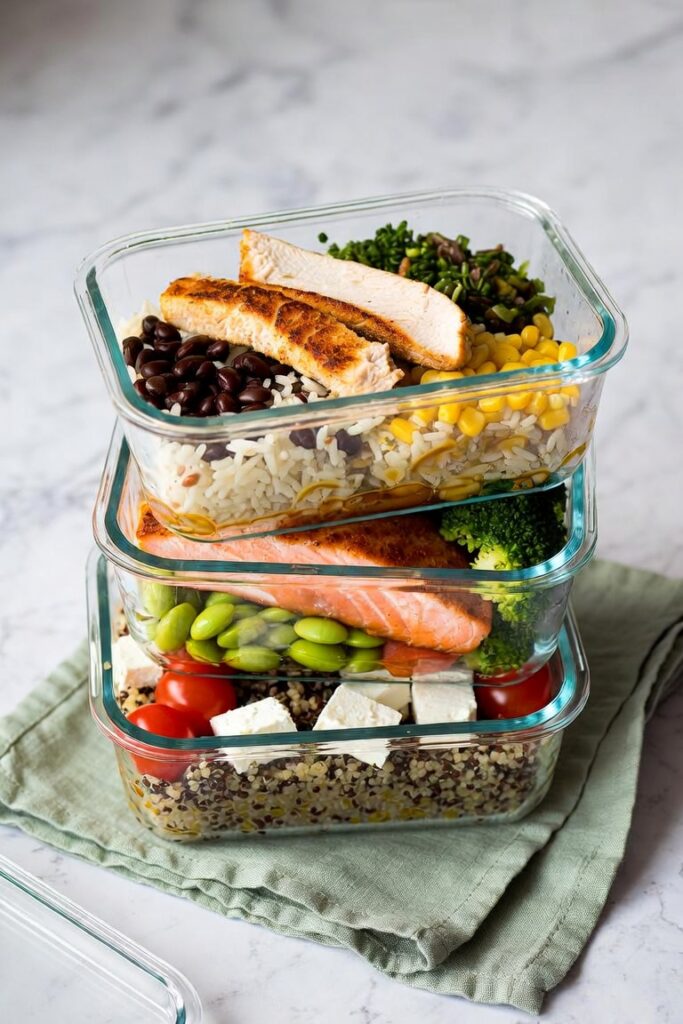
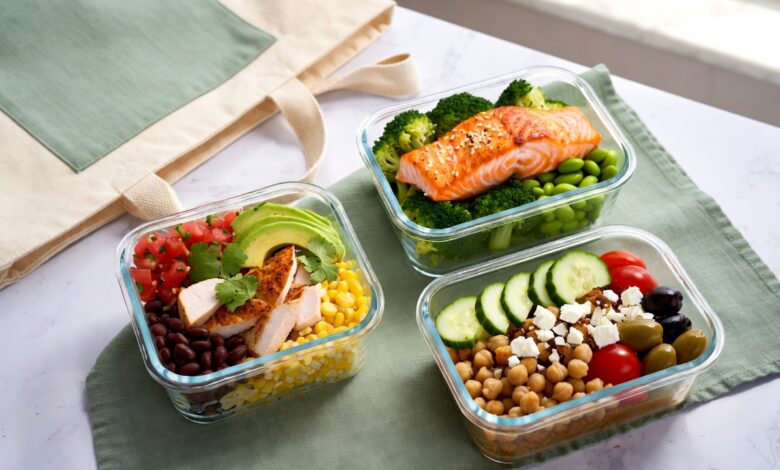
Once everything’s cooked, portioning is the fastest part of the whole process if your containers are already staged. Divide the protein, grain, and vegetables evenly across five or six containers, keeping sauces separate until serving. Compartmentalized containers help here, since they keep each component visually distinct and make it easy to eyeball proper portions without measuring each time — see our meal prep container guide for the best options. Label each container with the day if you’re prepping more than one flavor direction, so you’re not guessing which container is which by Thursday.

Tools That Make 30 Minutes Possible

Flat lay of sheet pans, a pot, a knife, and glass containers

A few tools make a genuine difference in hitting the 30-minute mark consistently. Two full sheet pans let you roast protein and vegetables simultaneously instead of in batches. A large pot with a lid speeds up boiling water for grains, and a rice cooker or instant pot removes grain-cooking from your attention entirely. A sharp chef’s knife cuts chopping time dramatically compared to a dull one, and a set of compartmentalized containers turns portioning into a two-minute task instead of a fifteen-minute one. None of this requires a big investment — most kitchens already have the sheet pans and a pot needed to start.

Scaling for a Family or Prepping for One

Split image comparing a single container to four sheet pans of food for a family

The building-block method scales in either direction without changing the 30-minute window much, since oven capacity — not your own active time — is what expands. For a family of four, use two full sheet pans of protein and two of vegetables instead of one each, and double the grain batch; the oven does the extra work while your hands-on time stays close to the same 30 minutes. Prepping for one person means you can go the opposite direction and prep a half batch, though it’s often just as fast to make a full batch and freeze half in individual portions for a future week, saving an entire prep session down the line.

Adapting the Routine for Different Diets

Flat lay of ingredient swaps for different diets including tofu and cauliflower rice

The building-block structure flexes easily across different ways of eating:

  • Vegetarian or vegan: swap the protein for beans, lentils, tofu, or tempeh, all of which cook in the same 15–20 minute window as meat or fish.
  • Low-carb or keto: replace the grain base with a double portion of roasted vegetables or a cauliflower rice alternative.
  • Gluten-free: rice, quinoa, and potatoes are all naturally gluten-free, so the core routine needs no adjustment beyond checking sauce ingredients.
  • Higher protein needs: double the protein portion in the same cook time by using a second sheet pan, since oven capacity is rarely the bottleneck.

What to Do When You Only Have 15 Minutes

Store-bought rotisserie chicken and a bag of salad greens on a counter

Some weeks won’t allow even 30 minutes, and that’s fine — the routine scales down. Pick just two components instead of four: a protein and a vegetable, or a protein and a grain, and skip the rest in favor of quick fresh additions at mealtime like a handful of greens or a piece of fruit. A rotisserie chicken from the store and a bag of pre-washed salad greens can replace the entire cooking portion of this routine in a pinch, leaving you with just five minutes of portioning. The goal on a short week is having something better than takeout ready to go, not a complete, perfectly balanced version of the full routine.

Keeping It From Getting Boring

Comparison of the same protein styled with two different spice blends

The building-block approach is naturally more resistant to boredom than prepping five identical meals, since you can vary the combination and sauce each day even with the same three or four base components. Change the spice blend on your protein week to week — taco seasoning one week, Italian herbs the next — to make the same base ingredients taste like a different meal entirely. Rotating between two grain options and two vegetable options across a month, rather than repeating the exact same combination every single week, keeps the whole system feeling fresh without adding real prep time.

Storage and Food Safety Basics

Hands labeling a glass meal-prep container with a marker

Let everything cool for about 10–15 minutes before sealing containers — sealing hot food traps steam, which speeds up spoilage and can make vegetables soggy. Cooked protein and grains keep for 4–5 days in the fridge; roasted vegetables are best within 4 days before texture starts to decline. If you want a longer runway, portion half the week into the freezer immediately after cooling, which extends most of these components to 2–3 months — see our 30 easy meal prep ideas for the week guide for more freezer-friendly combinations.

Common Mistakes That Blow Past 30 Minutes

Split image comparing a cluttered counter to an organized staged one
  • Skipping the setup step — hunting for ingredients and containers mid-prep is the single biggest reason a 30-minute plan turns into an hour.
  • Cooking components sequentially instead of in parallel, which doubles or triples your total time unnecessarily.
  • Choosing a protein or vegetable that needs constant attention, like pan-seared items that need flipping, instead of hands-off oven roasting.
  • Overcomplicating the sauce, which is meant to be a five-minute task, not a separate recipe with a long ingredient list.

A Sample 30-Minute Sunday Timeline

Five colorful glass containers lined up on a marble counter

Here’s how a real Sunday looks start to finish: at minute 0, chicken thighs go on a sheet pan seasoned with salt, pepper, and paprika, and a pot of rice goes on the stove. At minute 5, broccoli and bell peppers are tossed with oil on a second sheet pan. At minute 10, both pans go in a 425°F oven together. Between minutes 10 and 25, while everything cooks hands-off, a quick yogurt-garlic sauce comes together in a small bowl. At minute 25, everything comes out, cools for a few minutes, and gets portioned into five containers with the sauce added in small separate cups. By minute 30, the week’s lunches and dinners are done.

📌 Ready to try the 30-minute routine? Pin this guide to your Meal Prep board on Pinterest so you have the full timeline ready for Sunday!

Frequently Asked Questions

Can you really meal prep for a week in 30 minutes?

Yes — by cooking a protein, grain, and vegetables in parallel using the oven and stovetop at once, and doing your planning and staging in advance, 30 minutes of active cooking is realistic for most households.

What’s the biggest time-saver in a fast meal prep routine?

Cooking components in parallel rather than sequentially, and doing all your ingredient staging and decision-making before starting the clock.

How do I keep 30-minute meal prep from getting repetitive?

Vary the spice blend and sauce on the same base ingredients each week, and rotate between two grain and two vegetable options rather than repeating the exact same combination.

What if I only have 15 minutes on a busy week?

Scale down to just two components — a protein and a vegetable, or a protein and a grain — and lean on shortcuts like rotisserie chicken or pre-washed greens.

How long do the prepped components last in the fridge?

Cooked protein and grains keep 4–5 days, and roasted vegetables are best within about 4 days before texture starts to decline.

Do I need special equipment for this routine?

No — two sheet pans, a pot for grains, a sharp knife, and a set of compartmentalized containers cover everything, and most kitchens already have the basics.

How do I scale this routine up for a family?

Use two sheet pans of protein and two of vegetables instead of one each, and double the grain batch — the oven absorbs the extra volume so your hands-on time barely changes.

What’s the easiest way to start if I’ve never meal prepped before?

Start with just one protein and one vegetable rather than the full four-component system, and add a grain and a second vegetable once the basic routine feels comfortable.

Can I substitute ingredients if I don’t have exactly what a recipe calls for?

Yes — this system is built on categories, not specific recipes, so any protein, grain, or vegetable in the same general category swaps in without changing your cook time or method.

Is this routine cheaper than meal delivery kits or takeout?

Significantly — a week of protein, grain, and vegetables for two people typically costs $25–$35 total, compared to $60 or more for a few takeout meals alone.

What’s the best time of day to do this routine if not Sunday?

Any day with a 30-minute window works — many people do this Sunday evening after errands, but a weeknight before a lighter week ahead works just as well, since the routine doesn’t depend on it being the weekend.

Can I meal prep breakfast using the same building-block approach?

Yes — eggs, oats, and yogurt function as their own building blocks the same way protein and vegetables do here; see our high-protein breakfast ideas for meal prep guide for a breakfast-specific version of this same philosophy.

Related Articles

Leave a Reply

Your email address will not be published. Required fields are marked *

Back to top button