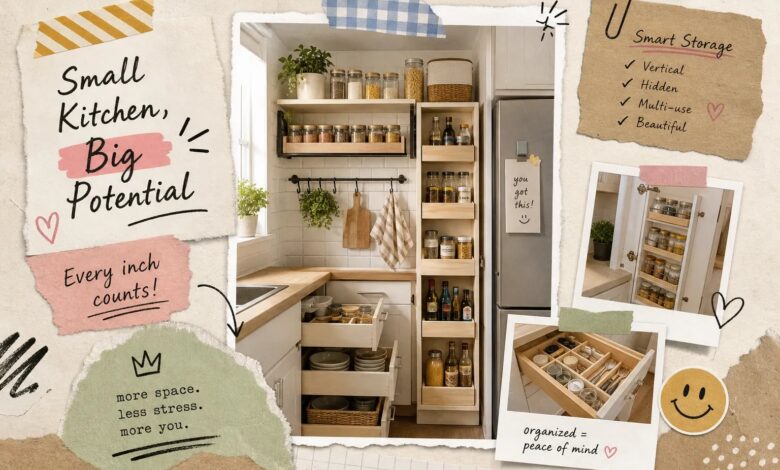
Tiny kitchen storage is one of those problems that compounds quietly. The counter disappears under appliances you use twice a month, drawers fill with tools you can’t identify, and the cabinet that should hold everything ends up holding nothing you can actually find. The frustration isn’t the square footage, it’s the absence of a system. At NestKitchenMeals, we’ve tested compact kitchen layouts across real renter setups and apartment kitchens, and what consistently works isn’t buying more containers. It’s placing the right organizer in the right zone. This guide covers six high-impact fixes ranked by where most people lose the most space first. Each one includes specific product types, realistic weight limits, and rental-safe installation notes so you can act quickly without second-guessing the fit. See also: recipes.
Before buying anything, measure two numbers: your base cabinet depth (standard U.S. base cabinets run 24 inches deep) and your counter-to-upper-cabinet clearance (the standard is 18 inches). Those two measurements will tell you which small-space kitchen organizers actually fit your kitchen rather than the idealized version of it.
1. Tiny kitchen storage starts on your walls: how vertical storage fixes that
Most small kitchens treat the wall above the counter as blank space. That stretch between your countertop and the bottom of your upper cabinets, roughly 18 inches of clear vertical real estate by standard measurements, is usable storage most people never touch. Any blank wall section beyond that is equally wasted. Vertical kitchen storage systems are the fastest way to move items off the counter without losing access to them, and they’re one of the most effective space-saving kitchen ideas available for any apartment layout.
Wall shelves and open shelving
Narrow open shelves with a depth of around 7 to 8.5 inches work well for spice jars, small bowls, and everyday cooking items without projecting so far that they block your workspace. A 12-inch-deep shelf matches standard upper cabinet depth and holds more substantial items. Most wall shelf installations require wall anchors or stud-finding for anything holding more than a few lightweight items. If your walls are drywall, locate the studs before mounting anything you plan to load with full spice jars or stacked dishware. Related reading: cooking tips.
Pot rails, peg rails, and pegboards
A horizontal rail mounted to a backsplash or unused wall section holds utensils, spice containers, and small pans on S-hooks, clearing entire drawers in one move. Pegboards offer the most flexibility because the hook layout adjusts as your needs change, and they scale to whatever wall space you dedicate to them. Some rail systems install with Command-style adhesive strips, which work for renters on smooth, clean, painted drywall or tile. Keep adhesive-mounted rails to lightweight loads: utensils, towels, and small tools. Standard indoor Command adhesives soften above roughly 104°F, and kitchen heat near the stove can push past that threshold, so check the product rating before mounting anything near a burner.
2. Squeezing more out of the cabinets you already have
The problem in most small kitchen cabinets isn’t total volume, it’s dead space. The back half of a standard 24-inch-deep base cabinet is mostly inaccessible because you can’t see or reach it without pulling everything forward. Upper cabinets lose capacity to stacking that creates an unusable layer underneath. Two simple organizer types fix most of this without any drilling, making them ideal tiny kitchen storage wins for anyone renting.
Under-shelf baskets and shelf risers
Under-shelf baskets clip onto existing shelves and create an instant second tier with no tools. They’re among the highest-gain small-space kitchen organizers available per linear foot because they double the usable surface of any shelf they attach to, and most drop into place in under a minute. Shelf risers work the same way inside cabinets, splitting a single shelf into two levels for plates, canned goods, or spice jars. Neither requires drilling, which makes both the first fix for renters who want results without landlord approval.
Pull-out shelves and lazy Susans for deep cabinets
For 24-inch-deep base cabinets, a pull-out shelf converts the unreachable back half into fully accessible storage. This is the single biggest overall volume gain of any cabinet organizer type because it reclaims space that’s already there but functionally wasted. Lazy Susans solve a different problem: corner cabinets where access, not depth, is the barrier. Match the fix to the actual problem, pull-outs for depth issues in base cabinets, lazy Susans for corner blind spots, and risers for stacking problems in upper cabinets. Buying a lazy Susan for a non-corner cabinet, or a riser for a deep base cabinet, won’t solve what’s actually wrong.
3. Tiny kitchen storage fix: the under-sink zone most apartment kitchens completely waste
The cabinet under the kitchen sink is almost always a disorganized catch-all in small apartments. Drain pipes running through the center make standard shelf inserts useless, so most people give up and shove cleaning supplies in randomly. That space can hold a surprising amount of organized storage if you work around the plumbing intentionally rather than ignoring it.
Stackable caddies and pull-out bins that route around pipes
U-shaped and adjustable-width under-sink organizers are designed specifically to clear the drain column. Two-tier pull-out systems that slide on a rail give you access to the back of the cabinet without reaching. Before ordering anything, measure from the cabinet wall to the outer edge of your pipe, and note whether you have a garbage disposal, which affects height clearance. In a standard 30-inch sink base, the interior working width runs around 27 to 29 inches in most U.S. apartment kitchen configurations, so check that measurement before sizing a pull-out frame.
Tension rod hacks for spray bottles and small bins
A tension rod stretched horizontally between the cabinet side panels holds spray bottles by their trigger handles, freeing the entire cabinet floor for bins and baskets. This is a zero-drill, renter-safe solution that works reliably for light loads. To install it, measure the interior cabinet width, buy a rod with a range that spans that measurement, and compress it into place between the side walls. Keep it to spray bottles and light cleaning cloths. A tension rod is an organization aid, not a structural mount, and overloading it will send everything to the cabinet floor.
4. Magnetic strips and over-door organizers: the rental-friendly power duo
Two of the most underused tools in compact kitchen storage require no wall damage and deliver immediate, visible results. Magnetic knife strips and over-door organizers belong in almost every small kitchen. Knowing their weight limits keeps you from loading them past what they can handle.
Magnetic knife strips and spice jar systems
A magnetic knife strip mounted to the wall or inside a cabinet door removes knives from the counter and frees a full drawer, often the most congested storage spot in a small kitchen. Self-adhesive versions are available for renters, though adhesive strips work best on smooth, flat, clean surfaces. Textured walls and high-humidity zones near the sink reduce adhesive reliability significantly. Magnetic spice jar systems that mount on the side panel of the refrigerator take zero counter or cabinet space and keep spices visible at eye level. That visibility also speeds up cooking, no more hunting through a drawer mid-recipe.
Over-door hooks and pantry door bins
Over-door organizers that hang from a cabinet or pantry door frame need no screws and handle light-to-moderate loads well. Good candidates include cutting boards, pot lids, cleaning supplies, foil and wrap boxes, and small storage bins. What to avoid: heavy pots, cast iron, or anything that exceeds what the organizer is rated for. Standard over-door systems are designed for light daily loads, not cookware. One practical note on clearance: if your door organizer projects several inches into the walkway, confirm your aisle is at least 36 inches wide. Below that, a door-mounted system adds projection that becomes a movement hazard rather than a storage solution.
5. Compact tools that eliminate storage problems before they start
Every bulky single-purpose appliance you own takes cabinet or counter space away from something more useful. Swapping a few key items for collapsible or multipurpose versions doesn’t just tidy the kitchen, it permanently reduces how much tiny kitchen storage you need in the first place.
Nesting and collapsible kitchen tools
Nesting bowl sets that stack colanders, sieves, and measuring cups into one compact footprint are a practical first swap for most small kitchens. Collapsible colanders and salad spinners fold flat and store in a drawer instead of taking up a full cabinet shelf. Look for options with strong durability ratings from everyday users, since collapsible tools that crack or lose their shape after a few months aren’t actually saving you space long-term. These aren’t compromises on function, they’re tools built specifically for kitchens where every cubic inch counts.
Multipurpose appliances that replace three with one
An immersion blender replaces a countertop blender and a food processor for most everyday tasks, and it stores in a single drawer slot. A compact air fryer replaces the toaster, the toaster oven, and supplemental frying gear in many apartment kitchens, consolidating three appliances into one with a smaller combined footprint. An Instant Pot or similar multi-cooker eliminates several single-function pots, along with the lids, cords, and accessories that come with each one. Each consolidation frees cabinet space and reduces the clutter that turns storage into chaos.
6. Where to start: matching the fix to your specific pain point
With six systems covered, knowing where to begin is the actual challenge. The most useful first step is diagnosing where your biggest storage loss is happening before purchasing anything. Counter clutter, cabinet chaos, and under-sink waste each have different first fixes, and buying the wrong solution for the wrong zone wastes both money and time.
A simple decision map for small kitchens
If counters are the problem, start with vertical wall storage and a magnetic strip. If cabinets feel full but disorganized, start with under-shelf baskets and a shelf riser, no tools, no drilling, immediate gain. If under-sink is the disaster zone, start with a U-shaped pull-out organizer sized to your cabinet width and one tension rod for spray bottles. Work one zone at a time rather than buying an entire organizing system at once. Most of the fixes in this guide cost under $50 and require no landlord approval.
NestKitchenMeals’ space-tested product picks for renters
At NestKitchenMeals, the small kitchen product picks section is built specifically for renters and apartment dwellers who don’t want to sort through hundreds of options to find what fits a compact space. The recommendations are organized by zone, counter, cabinet, under-sink, and over-door, and each pick is filtered for rental-safe installation and real-world fit based on standard U.S. apartment cabinet dimensions. If you’ve identified which section of this guide applies most to your kitchen, that resource gives you a shortlist rather than a research project.
One zone at a time is all it takes for better tiny kitchen storage
A small kitchen doesn’t have to feel like a compromise. Pick the zone causing the most daily frustration and start there. You don’t need to overhaul everything at once.
Most of these fixes require no drilling, no landlord permission, and well under $50. Once the right system is in place for one zone, the kitchen starts to feel different, less hunting, less stacking, less stress before you’ve even started cooking. The goal isn’t a perfect kitchen. It’s a kitchen that works without fighting you every time you open a cabinet. For more on this, see our kitchen decor guide.
If you want vetted product picks for each of these zones without the research rabbit hole, the NestKitchenMeals small kitchen guide has the shortlist ready, organized by zone and filtered for rental-safe installation so you can shop by your specific problem rather than browsing by category. For more on this, see our meal prep guide.