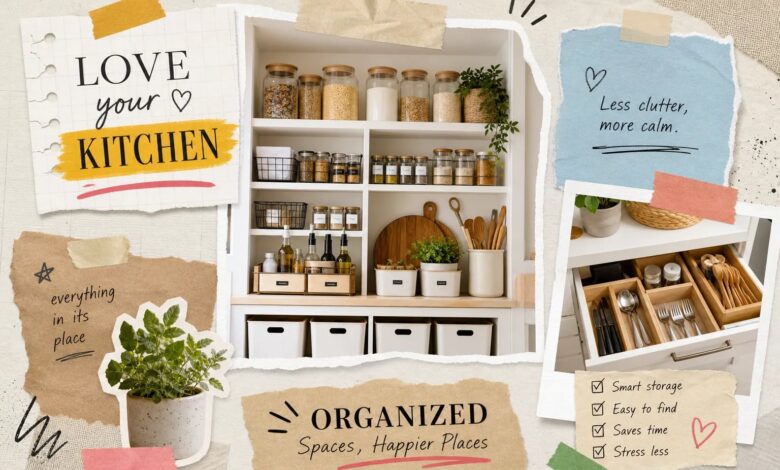
You open a cabinet to grab a pot lid and three things fall out. The counter has that permanent layer of stuff nobody put away. The pantry is technically organized, but finding the cumin takes longer than it should. If any of that sounds familiar, these kitchen organization ideas can help, and you don’t need a renovation to see real results. You need a plan.
At NestKitchenMeals, kitchen organization content lives right alongside our recipes and gear guides because a well-set-up kitchen is what makes cooking feel effortless, not just the recipe itself. These 15 kitchen organization ideas cover every zone: pantry, countertop, cabinet, and drawer. The emphasis throughout is on solutions that work for renters and real-world budgets. No power tools, no permanent installations, and nothing that requires a weekend to complete. You will find more ideas in kitchen decor.
1. Declutter first, organize second
Many organizing guides recommend purging before you buy a single bin or basket, and for good reason. The most powerful kitchen storage hack available costs nothing: decide what stays before you shop for organizers. Skipping this step is why so many tidy-looking kitchens still feel frustrating to cook in.
How long does a kitchen reset actually take?
Be honest with yourself before you start. A single counter or drawer takes 10 to 20 minutes to reset. One cabinet zone runs 30 to 60 minutes once you pull everything out and sort it. A full kitchen reset covering counters, cabinets, pantry, fridge, and under-sink storage takes 2 to 4 hours. If you have a large kitchen with years of accumulated items, plan for a full day. Knowing this upfront helps you decide whether to tackle everything in one Saturday afternoon or break it into short sessions across a week.
The zone-by-zone order that saves the most time
Start with the counters: clear everything off, wipe them down, and only bring back what truly belongs there. Next, remove anything that doesn’t belong in the kitchen at all, mail, chargers, paperwork. From there, work one category at a time: dishes, pots and pans, utensils, food storage containers, and appliances. Pulling every item from one category together at once makes duplicates obvious and decisions fast.
One rule that keeps clutter from rebuilding
Apply the one-in-one-out rule: when something new comes into the kitchen, something old leaves. Pair that with the habit of putting things away immediately after use, not setting them down temporarily. Together, these two habits help prevent clutter from returning and keep a freshly reset kitchen from sliding back into chaos.
2. Pantry organization ideas that actually hold up
The pantry has a direct line to how smoothly your cooking goes each day. A disorganized pantry means buying duplicates of things you already own, losing ingredients before you use them, and standing there staring blankly when you’re trying to pull dinner together. These strategies work in a standard reach-in pantry just as well as a larger walk-in.
Group by category, not by container size
Organizing by how things physically fit together is what makes pantries feel like a puzzle nobody can solve. Instead, assign zones by food category: grains, canned goods, snacks, baking supplies, sauces and condiments. The most-used items belong at eye level on the middle shelves. Heavy canned goods and bulk items go lower. Specialty or rarely used ingredients go higher. That single shift in approach changes how usable a pantry feels on a daily basis.
Clear bins and labels do most of the work
Stackable clear bins are the most versatile pantry organizer at almost any budget. They consolidate loose items, make it easy to see when something is running low, and keep categories contained when multiple household members are reaching in. Label every bin clearly enough that anyone in the house can return an item to the right spot without guessing. Even a handwritten label on masking tape outperforms no label at all.
Kitchen organization ideas for pantries on a tight budget
Repurposed jam jars work well for storing pantry staples like dried herbs, rice, or lentils. Cereal boxes cut into open-front holders create instant bin organizers on pantry shelves. Tension rods placed vertically between shelves separate canned goods and prevent them from rolling or toppling. These low-cost swaps are especially useful if you’re renting, working with a limited budget, or just getting started on your first real organization project.
3. Top kitchen organization ideas for countertops and wall storage
Counter space is the most valuable real estate in any small kitchen. The goal isn’t to store more on the counter, it’s to keep it clear enough to actually use it. These strategies do both.
Only what earns counter space stays on the counter
Treat counter organization as an audit. Every item sitting on the counter needs to justify its spot by being used at least three or four times a week. The coffee maker usually earns it. The toaster probably does too. The decorative bowl of miscellaneous objects does not. Anything used once a week or less belongs in a cabinet or drawer. That mental filter is what prevents counters from refilling within days of a good clean.
Wall-mounted solutions any renter can use
Among the most effective and commonly recommended wall-mounted options for small kitchens are a pegboard system for tools and pots, a magnetic knife strip, and wall-mounted hooks for mugs or measuring cups. For renters, adhesive mounting strips rated for the appropriate weight are a genuine no-damage alternative that holds up well when installed correctly on smooth, compatible surfaces, though they’re best suited for lighter items like hooks and strips rather than heavy pots or cast-iron pans, which typically need hardware support. Vertical wall space in a small kitchen is almost always underused, and tapping into it frees up cabinet and counter space without buying a single piece of furniture. If you want to go further, kitchen counter decor ideas: 8 simple ways to style your space covers it in detail.
The slim rolling cart trick
A narrow rolling cart that slides beside the refrigerator or under a counter overhang solves one of the most common small-kitchen problems: items that have no good home end up colonizing the counter. Use the cart for spices, oils, vinegars, snacks, or whatever tends to pile up on your surface. It rolls out when you need it and tucks back in when you don’t. The floor footprint is minimal, and it requires zero installation.
4. Cabinet upgrades that double your storage overnight
Most kitchens treat cabinet interiors as fixed spaces when they’re anything but. A standard cabinet has significantly more usable room than most people actually access. Shelf risers and similar in-cabinet add-ons typically cost under $30 and require no tools, though pull-out trays and blind-corner organizers can run higher and may involve simple installation. Even the entry-level options make a noticeable difference within an hour.
Shelf risers: the easiest upgrade you’re not using
Cabinet shelf risers create a second level inside a single shelf, which effectively doubles the stacking space for plates, bowls, mugs, or pantry goods. No installation is required: they sit directly on the shelf. Wire risers work well for dishes and glassware because they’re lightweight and easy to reposition. Solid platform risers are better suited for heavier pantry items. The Brightroom Metal Cabinet Shelf from Target is well reviewed and sits well under $30, a reliable first buy for most kitchens.
Pull-out trays for the deep cabinets you never reach into
Deep cabinets are where things go to disappear. Items at the back get buried by items in the front, and eventually you forget what’s back there. Pull-out cabinet trays and sliding organizers solve this by bringing the back of the cabinet to you. For corner cabinets specifically, a blind-corner organizer is worth the slightly higher price because it reclaims space that would otherwise go unused entirely.
Inside-the-door storage that most people ignore
The inside surface of a cabinet door is the most consistently overlooked storage space in the kitchen. Mounted racks hold pot lids upright so they’re easy to grab and return. Shallow bins on door-mounted rails store spice packets, small condiment packets, or plastic bags. Hooks hold measuring cups or oven mitts. For small kitchens especially, each door surface is bonus storage that doesn’t require giving up any shelf space.
5. Drawer organization that ends the utensil scramble
A messy kitchen drawer slows down every cooking session, you’re digging for the spatula while something on the stove needs attention. The fixes here are quick, low-cost, and don’t require replacing or modifying any existing hardware. For more on this, see our cooking tips guide.
Start with a flatware tray and a utensil organizer
In many kitchens, drawer chaos is solved with just two products: a flatware tray for silverware and a multi-compartment organizer for cooking utensils. Before buying either, measure the drawer’s interior dimensions. An organizer that doesn’t fit the drawer properly will shift around constantly and undercut the whole system. Get the measurements right first, then shop.
Bamboo vs. plastic drawer dividers: which is worth it
Bamboo expandable dividers, including the SpaceAid and Pipishell options that tested well in 2026 roundups, are the stronger long-term pick for kitchen drawers. They hold their shape over time, adjust to fit different drawer widths, and look clean without requiring much maintenance. Plastic modular sets like the Vtopmart 25-piece system are lighter, cheaper, and easier to wash, making them a solid choice for smaller drawers or anyone on a tighter budget. Match the product to what your drawer actually needs rather than defaulting to one category automatically.
A simple system for the junk drawer
Most kitchens have one catchall drawer, and that’s fine. The goal isn’t to eliminate it but to corral it with small bins or a modular plastic set so that batteries, rubber bands, takeout menus, and miscellaneous items each have a designated compartment. A sorted junk drawer is far more functional than a perfectly organized kitchen with no logical home for small odds and ends.
How to prioritize your changes and get started
Fifteen strategies can feel like a lot. The goal isn’t to do all of them at once; it’s to choose 6 to 8 high-impact changes and work through them in order. Start with the zone you use most. For most home cooks, that’s the pantry or the main prep counter. If you’re renting, prioritize solutions that don’t require any drilling or permanent installation. For first purchases, stay under $50 and focus on the zones that cause the most daily friction.
A general budget breakdown helps frame the investment: under $10 covers labels, tension rods, and DIY bin solutions. Between $10 and $30 gets you shelf risers, drawer trays, and clear pantry bins. Between $30 and $60 covers a slim rolling cart, pull-out cabinet systems, or a basic pegboard setup. Prices vary by region and retailer, but that tiered approach lets you start immediately without waiting until you can afford to overhaul everything at once.
The NestKitchenMeals kitchen organization hub goes deeper on every zone covered here, with product roundups written from a home cook’s perspective. The recommendations are built for real-world budgets and apartment-sized kitchens, which makes them more useful for most readers than high-end gear coverage aimed at professional setups. Zone-specific guides, product comparisons, and a breakdown of what’s worth buying versus what you can DIY are all there when you’re ready.
Quick kitchen organization tips: common questions answered
What are the best kitchen organizers to buy first?
Start with shelf risers, a drawer flatware tray, and a set of clear pantry bins. These three purchases address the most common pain points, cluttered cabinets, tangled utensils, and an unreadable pantry, and together cost well under $50.
What are the best kitchen organization ideas for small kitchens?
Small kitchen organization works best when you go vertical. Wall-mounted strips, pegboards, and over-door racks reclaim space without shrinking your footprint. A slim rolling cart beside the fridge adds storage without a permanent fixture. Prioritize drawer dividers and cabinet shelf risers to maximize every inch of existing storage before adding anything new.
How do I keep my kitchen organized after a reset?
Two habits do most of the work: the one-in-one-out rule and putting items away immediately after use rather than setting them down temporarily. Label every bin and zone clearly enough that anyone in the household can maintain the system, not just the person who set it up.
Are there kitchen organization tips that work for renters?
Renters have more options than they often realize. Adhesive mounting strips, tension rods, freestanding carts, and over-door organizers all require zero drilling and leave no damage. Avoid anything that requires wall anchors or permanent hardware, and you’ll have a fully organized kitchen you can take with you when you move.
A kitchen that works is worth more than one that looks good
Kitchen organization doesn’t require a renovation or a significant budget. It requires starting in the right order, decluttering before you organize, and choosing products that fit the actual space you have. A few maintenance habits keep the work from unraveling.
The four zones covered in this article (pantry, countertop, cabinet, and drawer) each have practical, low-cost solutions that make a measurable difference in daily cooking. The goal was never a showroom kitchen. It’s a kitchen where you can find the cumin, the cutting board has space to land, and dinner comes together without unnecessary friction.
When you’re ready to go deeper on any of these kitchen organization ideas, NestKitchenMeals has zone-by-zone guides, specific product picks, and meal prep strategies built around the same no-fuss approach. Start with one zone, work through it fully, and move to the next.